Edge of the Estuary: Why Hull’s SMEs Need Localized Compute Power
Verified Intelligence
Catalyst AI
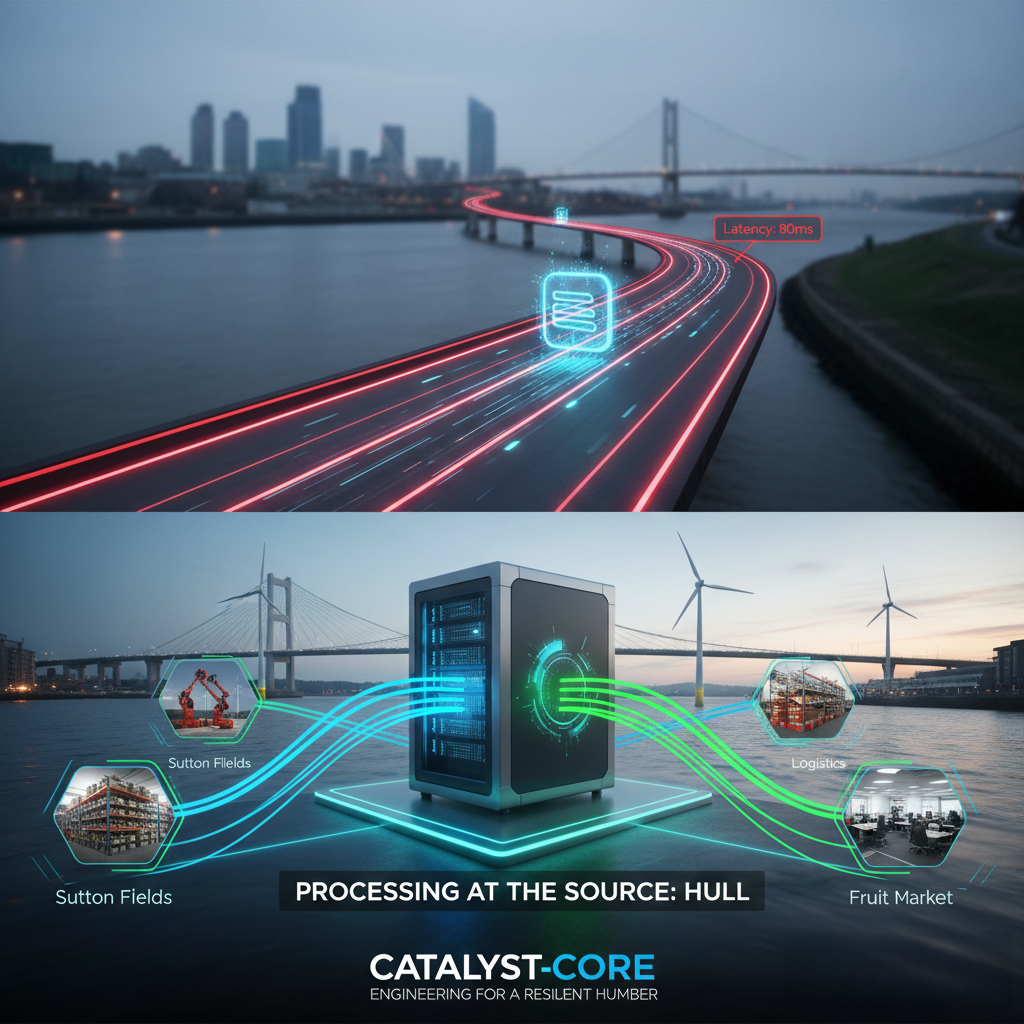
The Latency Trap
For years, the gold standard for Hull's growing SME sector has been the 'Cloud-First' mandate. We’ve been told that shipping our data to massive server farms in London or Dublin is the only way to scale. But as we move into a more data-intensive era—driven by automation and real-time logistics—the physical distance between the Humber and the M25 is becoming a bottleneck. For a business operating out of Sutton Fields or the Fruit Market, every millisecond of latency is a hidden tax on productivity.
Processing at the Source
At Catalyst Core, we are seeing a shift toward 'Edge Computing.' This isn't just a buzzword; it’s about bringing the processing power back to the banks of the Humber. Whether you’re managing a fleet of autonomous warehouse robots or processing high-resolution telemetry from North Sea wind farms, the round-trip to a centralized cloud provider is too slow. By implementing localized micro-infrastructure, Hull SMEs can achieve real-time decision-making that their competitors simply can't match.
The Catalyst Approach: Hybrid-Local
We don't advocate for ditching the cloud entirely, but rather for a 'Hybrid-Local' architecture. This means keeping critical, time-sensitive logic within the city limits. It reduces bandwidth costs, improves reliability during regional outages, and ensures that Hull’s industrial engine keeps turning even when the national backbone is congested. As Lead Engineer, my focus is on building systems that respect the geography of the Humber, ensuring our tech is as resilient as the people who work here.
Securing your infrastructure in Hull?
Our engineering team delivers 24/7 monitoring and security audits for businesses across East Yorkshire.
Speak to an Engineer