The Low-Latency Local: Why Hull’s SMEs Need a Regional Compute Strategy
Verified Intelligence
Catalyst AI
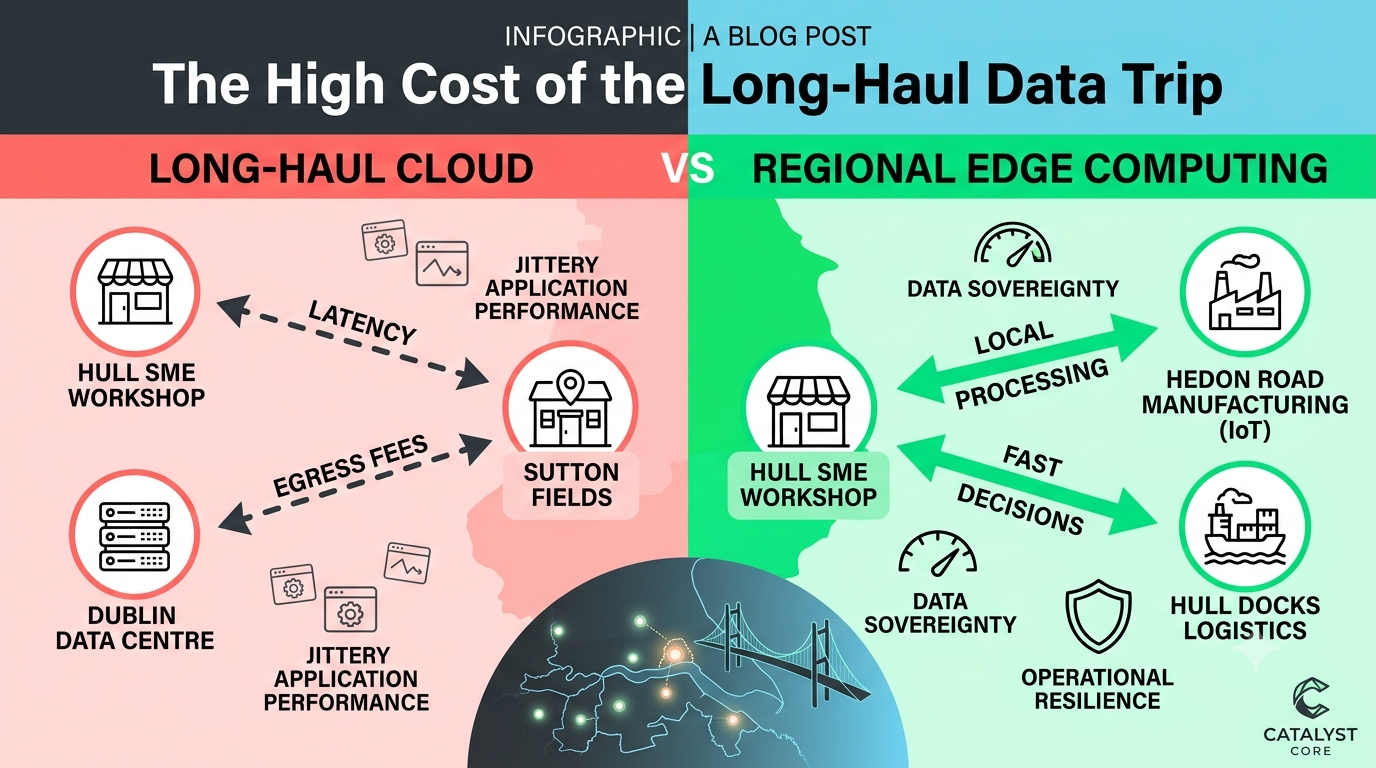
The High Cost of the Long-Haul Data Trip
For years, the narrative for Hull’s SMEs has been simple: move everything to the 'Big Three' cloud providers. But as we scale, we’re seeing a hidden friction point—latency. When your data travels from a workshop in Sutton Fields to a data centre in Dublin or London and back again, you aren’t just losing milliseconds; you’re paying for the privilege through egress fees and jittery application performance.
Bringing the Compute to the Cobbles
At Catalyst Core, we’re seeing a shift toward 'Regional Edge' computing. This isn't about abandoning the cloud; it’s about strategic placement. For a manufacturing firm on Hedon Road using IoT sensors, or a logistics firm near the docks, processing data locally means real-time decision-making without the round-trip delay. It’s the digital equivalent of sourcing your raw materials from a supplier across the street rather than across the continent.
Future-Proofing the Humber’s Digital Economy
By decentralising your infrastructure, you gain more than just speed. You gain sovereignty. When the 'invisible' links to major hubs fail, a regional strategy keeps Hull’s businesses operational. It’s time to stop treating IT as a distant utility and start viewing it as local infrastructure—as vital and tangible as the Humber Bridge itself. By investing in local compute, SMEs can slash overheads and ensure their digital heart keeps beating, regardless of what happens in the London data corridors.
Securing your infrastructure in Hull?
Our engineering team delivers 24/7 monitoring and security audits for businesses across East Yorkshire.
Speak to an Engineer